
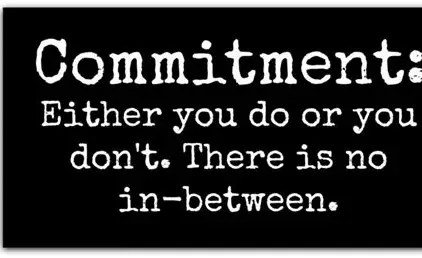
For a scene to go well in improv, you’re either all the way in or you’re out. When the scene has you and the other actors out in the water surfing and suddenly someone has Godzilla poking his head out of the water, that’s a decision point for you: you’re either all the way in or you’re out. You either convince the audience that you see the big guy as clear as a bell and you are freaking out or you take the audience out of the moment as you roll your eyes in disbelief that one of your fellow actors has done this. What good improv actors know is that they must commit fully both to the scene and to the other actors. Their commitment to the scene is based on their respect of the craft and their desire to demonstrate excellence in every scene no matter how difficult or ridiculous. But it’s the second commitment that may run more deeply. It’s their commitment to the fellow actors. Their desire to work together to create something special and their determination not to abandon them when the going gets tough.
Pretty easy to connect all that with marriage, isn’t it? When a couple gets married, they sign on to the idea of two people making promises to live together in a certain way. This is a beautiful and sacred thing that, as the old ritual used to say, should not be entered into lightly or unadvisedly. Marriage is the structure on which cultures are built. It’s how families are created but more than that, it’s how we support and care for one another and can have an orderly society. We regard it as being nothing less than coming from God who gave it to us as a gift. The heart of what we promise in marriage is to be faithful. Many years ago, I was with a group of clergy friends. One of them started talking about a situation in which a parishioner had begun flirting with him and the awkwardness of how to handle it from a pastoral perspective. From that the conversation devolved into kind of a bragging session about all the times each of these friends had experienced this. As I sat there, I came to the realization that I didn’t have one single story to contribute. I wondered if it had been happening to me and I was just too clueless to notice or was I really that big a loser! I’m fully convinced that none of my colleagues conducted themselves in an inappropriate manner. But it did get me to thinking about how affairs happen. I’m convinced it happens not because of one big decision but because of a hundred little decisions that ultimately lead to infidelity. It’s the gaze at another person that lingers a little too long. An innocent touch that isn’t so innocent. It’s a thought, just a little thought. It’s the situations we willingly put ourselves in that no married person who is committed to marriage should allow. It’s a hundred little decisions. And you look up and wonder how you got yourself into this mess. Being committed to our marriage is just like the improv actor being committed to the scene: in the little decisions we make each day we are either all in or we’re out .
And like the improv actors, the commitment is not just to marriage. More than that, the commitment is to another person. I used to hear spouses say it when they were struggling. They’d say: “Now, preacher, I’m committed to my marriage.” They would say it as if they were saying something high and noble. And at one level they are. When it’s not easy being married, a declaration of commitment to the idea of marriage has a certain nobility to it. But it’s not enough, is it? When we get married, we are not just committing ourselves to an idea. We are making a commitment to another person. On occasion I’ve had couples who perpetuated their marriage by one of them living on the first floor of the house and the other on the second. This was done not as a short-term separation while they worked through difficult issues but as an unnatural way of continuing the marriage. When we get married our commitment is to a person. That means we are committed to being an integral part of his or her life. We are committed to connecting with that life and knowing our spouse deeply. We make it a priority to be with them and when we are with them we make it a priority to actually be with them. (If you don’t understand that sentence then you aren’t married.) Sometimes work and life cause married people to live apart. My wife and I did it for several years. But it’s a decision a couple makes together. As they live into that decision, they make it a priority to be together as they are able and then intentionally make the most of those precious days.
Being fully committed to our spouse means we are committed to his or her happiness and well-being. Their joys become our joys. We fully participate in their moments of sorrow and struggle. It doesn’t mean we lose our separate identities but it does mean we want to be a part of theirs. When our spouse is celebrating, we celebrate with them. When our spouse is crying, we cry with them. When our spouse has a problem and wants to talk about it, we listen. We ask questions to help in processing it. Maybe we give advice. Maybe. If they ask for it. We might want to make sure they really want it by having them ask twice. Mostly we listen. And if you are believer, pray for and with your spouse on a regular basis. Whatever they are into, we are into. If our spouse gets into bowling, we may not become bowlers (or maybe we do!), but we become interested in bowling. We want to hear about their games and what happened in the latest tournament. We ask questions about it and are (or at a minimum appear to be!) interested in it. If our spouse is a computer programmer, we may not become a programmer, but we want to hear about what the latest project is and how it’s going. We ask questions about it and are (or at least at a minimum appear to be!) interested in it. You get the idea. When we got married, we didn’t just commit to an idea. We are committed to a person.
And its got to be both. It can’t be just one person doing these things. This commitment is a mutual commitment. It takes two people to start a marriage. I fully believe it only takes one person to end a marriage. When one of the two has checked out, when one of the two has come to the conclusion this thing is more trouble than its worth, the marriage is effectively over. When I was reading about this idea of fully committing, one person said it really well. He said: By taking ownership and committing to our choices, we look forward instead of backward. We say, “I’m going to make this work” instead of “Did I make a mistake?” When there are two people in a marriage that are doing those things: taking ownership and committing to their choices; looking forward instead of backward; and saying: “I’m going to do what I have to do make this work.” instead of “Did I make a mistake?”. When you have two people doing those things, I think that marriage will be just fine.
Next Principle: Take Risks